Fast facts before the detail
At a Glance: What Parents Need to Know
This summary answers the main decision points. The sections below explain the method, conditions and limitations in context.
| Decision point | Position |
|---|---|
| Most direct benefit | Structured practice in number representation, arithmetic technique and accuracy. |
| Mental-abacus benefit | A visual calculation strategy introduced after physical skills become stable. |
| Research position | Arithmetic gains appear in some longer studies; wider cognitive findings are mixed. |
| Not guaranteed | IQ, memory, concentration, school marks or the same result for every child. |
| Progress signs | Correct technique, place value, accuracy, independence and stable performance over time. |
| Role in education | A focused arithmetic enrichment method, not a replacement for school mathematics. |
Start with what the child actually does
What Does ‘Abacus Benefit’ Mean?
A benefit claim is strongest when it stays close to the learning activity. A child who repeatedly represents numbers on place-value columns is directly practising place value. A child who completes addition and subtraction sets is directly practising arithmetic. A child who later pictures bead positions is directly practising a visual calculation strategy.
Claims become less certain when they move further away from the activity. Saying that a lesson requires attention is accurate. Saying that it will permanently improve concentration in every subject is a much larger claim. The same distinction applies to memory, reasoning, school marks and IQ.
| Type of claim | Example | How parents should read it |
|---|---|---|
| Directly practised skill | Place value, bead movement, addition or error checking | Part of the learning activity and visible during lessons. |
| Near learning outcome | Improved performance on trained or closely related arithmetic | Plausible and supported in some studies, but dependent on training and learner. |
| Wider transfer | General memory, concentration, grades or problem-solving | Evidence is mixed; do not treat it as a promised result. |
| Marketing overclaim | Guaranteed IQ, photographic memory or “whole-brain” development | Too broad to use as a responsible enrolment promise. |
Direct practice before broad promises
12 Abacus Skills Children Can Practise
Place-value representation
Children place ones, tens, hundreds and larger values in separate columns and see how a movement changes the represented number.
Number and quantity connection
Numerals are linked to a bead pattern rather than treated only as written symbols, giving the learner another way to represent an exact value.
Arithmetic procedures
The child follows taught sequences for addition and subtraction, then later operations when the required foundations are secure.
Calculation accuracy
Bead positions and answers can be checked step by step, allowing the trainer to identify a wrong column, value or movement.
Arithmetic fluency
Repeated correct work can make familiar calculation procedures more efficient and reduce the effort needed for each taught step.
Controlled calculation speed
Pace can increase after accuracy becomes stable. The useful skill is reliable fluency—not moving quickly without understanding.
Coordinated finger movement
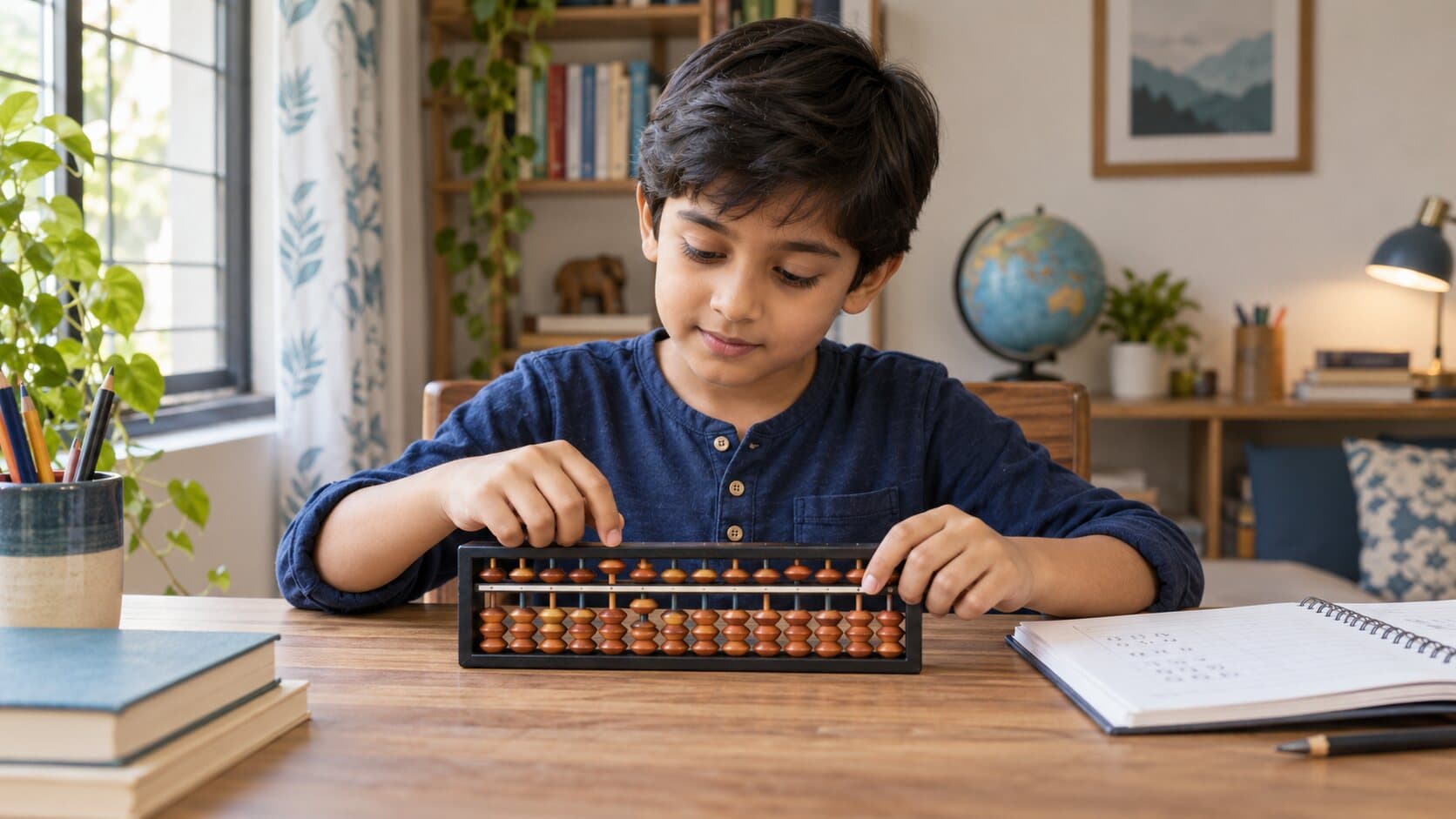
The physical abacus requires the child to select a column and move a particular bead with the assigned finger technique.
Visual bead representation
Learners begin to recognise familiar bead patterns and, at a suitable stage, recall those patterns without looking at the tool.
Mental calculation strategy
Mental abacus provides a specific visuospatial calculation strategy for work already mastered on the physical frame.
Holding steps in mind
Multi-step work asks the child to retain a running value while applying the next movement. This uses working memory during the task.
Structured practice habits
A short, consistent routine can teach the learner to prepare materials, attempt an assigned set, check work and report difficulties.
Arithmetic independence
Progressively fewer prompts can help a child complete familiar work alone and explain when a correction is needed.
Important distinction
These are skills or behaviours practised through the method. The degree of improvement, time required and transfer beyond abacus tasks differ from child to child.
Positive, null and mixed findings together
What Does Research Say About Abacus Benefits?
Research does not support a simple “abacus improves everything” conclusion. Different studies use different ages, countries, training periods, comparison lessons and outcome tests. Parents should look at the design and the measured task—not only the positive sentence in an abstract.
| Study | Design | Main finding | Responsible interpretation |
|---|---|---|---|
| Barner et al., 2016 | Three-year randomized trial at one school in India; 204 children enrolled and 183 entered the longitudinal analysis | Mental-abacus students outperformed controls on arithmetic tasks. The study did not detect training-related changes in the basic cognitive measures it assessed. | Supports trained arithmetic benefits; does not support a general memory or intelligence guarantee. |
| Barner et al., 2018 | One-year classroom-randomized US trial with first- and second-grade students | No significant advantage in cognitive ability or mathematical computation; second graders learned the method more successfully. | In this implementation, neither grade showed a significant computation or cognitive advantage. |
| Wang et al., 2015 | Randomized longitudinal study: 82 recruited, 70 remained after initial exclusions and 68 entered final analyses; the abacus group received two hours of training per week | The trained group performed better on arithmetic and visual-spatial mathematics tests and responded faster in a switching task; switch cost did not differ. | Some outcomes improved, but the executive-function result was not a blanket task-switching benefit. |
| Wang et al., 2019 | Five-year child study from one district; 144 were randomized, 112 entered behavioural analyses and 50 entered the final fMRI analysis | The abacus group performed better on arithmetic and visuospatial working-memory tasks, with no significant Raven IQ difference. Neural activation differences were reported in the final imaging sample. | Supports a possible visuospatial pathway, while the single setting, attrition, smaller imaging sample and other null trials limit generalisation. |
| Liu et al., 2026 | Observational comparison of 488 children in grades 1–5, including 256 learners with 3–39 months of abacus-based mental-calculation experience | Abacus learners performed better on arithmetic, numerical processing, short-term memory and attention measures; the estimated pathways differed by grade and learning duration. | The findings show associations, not proof that abacus training caused every group difference. |
These studies are informative, but none predicts the result for an individual child or proves that every commercial course produces the same training quality, duration or outcome.
The benefit closest to the method
How Can Abacus Learning Support Arithmetic?
The most defensible reason to learn abacus is arithmetic practice. The child represents a value, performs a taught movement and checks the result. With suitable progression, this can cover addition, subtraction, multiplication, division and increasingly complex sequences.
What can improve through direct practice
- Recognising and setting place values
- Following the taught operation sequence
- Completing familiar calculations accurately
- Finding repeated movement or column errors
- Calculating familiar problem types more fluently
- Using an imagined abacus for suitable tasks
What still needs wider mathematics teaching
- Explaining why every mathematical rule works
- Interpreting word problems and real situations
- Geometry, measurement, data and patterns
- Written reasoning and multiple solution strategies
- Grade-specific school methods and notation
- Applying mathematics in unfamiliar contexts
This is why the abacus syllabus should be read as an enrichment pathway, not as a replacement for the school curriculum.
Practised during a task is not guaranteed everywhere
Can Abacus Improve Concentration and Memory?
An abacus lesson asks a child to attend to the number, choose the correct column, remember a running value and execute a sequence. Those demands are real. A parent may observe longer engagement or fewer prompts as the learner becomes familiar with the method.
However, task demand is not the same as proven general transfer. The three-year randomized trial by Barner and colleagues found arithmetic gains but did not detect training-related changes in the basic cognitive measures it assessed. Other studies, including Wang and colleagues’ 2019 research, report visuospatial working-memory differences. Taken together, the evidence is mixed and depends on the skill, test and programme.
A careful way to describe the benefit
Say: “Abacus lessons require and practise focused, step-by-step attention and temporary handling of numerical information.” Do not promise: “Abacus will improve every child’s concentration and memory in all settings.”
A specific visual calculation method
What Is the Benefit of Mental-Abacus Visualisation?
Mental abacus is not simply “doing sums in the head.” The learner creates and changes an internal image of bead positions. Research indicates that users manipulate a visuospatial representation of bead positions while calculating.
- 1
Operate the physical tool
The child first learns reliable bead values, columns and finger movements.
- 2
Recognise stable patterns
Familiar values and operation steps become easier to recall.
- 3
Picture short movements
The trainer introduces visualised work that matches an already stable physical skill.
- 4
Extend carefully
Longer sequences or new operations are added only while accuracy remains reliable.
Rushing this sequence can leave the child guessing at an image without a dependable physical foundation. The benefit comes from a controlled transition, not from removing the abacus as quickly as possible.
A possible experience, not a universal result
Can Abacus Build Confidence and Independent Learning?
A concrete method can make arithmetic feel more manageable for a child who enjoys visible steps and repeated practice. Small, observed improvements—setting numbers correctly, completing a set without prompts or correcting an error—can create a useful sense of progress.
Confidence can also fall when children are compared publicly, pushed for speed or moved ahead before the current skill is stable. A responsible programme uses accuracy, independence and readiness as progress signals and does not treat performance as a measure of intelligence.
| Helpful condition | What the child may experience | Risk to avoid |
|---|---|---|
| Tasks at a suitable level | Enough challenge to learn without constant failure | Advancing only because a fixed calendar says so |
| Specific correction | The learner knows what to change next | Calling a child careless without identifying the movement |
| Accuracy before timing | A stable method develops before pressure increases | Rewarding fast guesses or copied answers |
| Visible progress notes | The child and parent can see a practical next step | Using vague praise or guaranteed future claims |
Fit matters more than a universal start age
Which Children Are Most Likely to Benefit from Abacus Classes?
A child is more likely to benefit when the starting work matches current number knowledge, the physical tool feels manageable and the family can support short practice without conflict. At Abacus Experts, age five is an approximate starting guide rather than an automatic enrolment rule.
Useful readiness signs
- Recognises the basic numbers used in the starting activity
- Can count a small set with reasonable stability
- Can follow one or two short instructions
- Can sit for a brief guided learning task
- Is willing to try controlled finger movements
- Can tolerate correction without sustained distress
Reasons to pause or adjust
- Number recognition is not yet secure
- The child guesses rather than following the demonstrated step
- The tool or pace creates repeated frustration
- A sensory, motor or communication need is not supported
- The family cannot sustain the assigned practice routine
- A broader learning difficulty needs appropriate assessment
See the complete age and readiness guide or use the free assessment to discuss an individual starting point.
Look for stable skills, not one impressive display
How Can Parents See Whether Abacus Is Benefiting Their Child?
| Progress area | Useful evidence | Weak evidence by itself |
|---|---|---|
| Technique | Correct fingers, columns and bead movement across several sessions | One memorised demonstration |
| Place value | The child can set and explain the represented number | Copying the trainer without explaining the value |
| Accuracy | Fewer repeated errors on current and mixed practice | One perfect worksheet completed with help |
| Independence | Starts and completes familiar work with fewer prompts | A parent supplying the next movement |
| Fluency | Faster work while technique and accuracy remain stable | A stopwatch result with guessing or hidden errors |
| Visualisation | Mental work matches operations already secure physically | Air movements without a correct answer or explanation |
Progress should be judged over time and against the child’s previous performance, not another learner’s speed. Read the progress and assessment standards for the complete observation framework.
The honest answer includes what abacus cannot do
Abacus Limitations, Disadvantages and Common Myths
It does not cover all mathematics
Abacus is concentrated on number representation and arithmetic. It does not replace geometry, measurement, data, reasoning or applications.
Transfer is not automatic
Better performance on abacus or practised arithmetic does not guarantee higher grades, better reading or stronger attention everywhere.
Practice quality matters
Repeated incorrect movements may become harder to correct. Live observation and early correction are important.
Speed can distort the goal
Timing too early may reward guessing, hide weak place value and create pressure for some children.
Children respond differently
Readiness, visual-spatial demands, practice tolerance and learning preferences affect how easily the method is acquired.
It is not a clinical intervention
An abacus class cannot diagnose or treat a learning, attention, developmental, motor or mental-health condition.
Claims Abacus Experts does not make
We do not promise higher IQ, photographic memory, “left-brain and right-brain activation,” guaranteed concentration, guaranteed school marks, a fixed completion time or identical outcomes for every child.
A benefit depends on how the class is taught
How Should Parents Choose an Abacus Class?
- Ask whether placement considers readiness and previous learning.
- Review the written syllabus and the physical-to-mental sequence.
- Confirm who teaches the class and how experience is described.
- Check whether the trainer can observe and correct finger technique.
- Ask how batch size affects individual correction.
- Understand the expected home-practice routine.
- Request specific progress measures beyond attendance.
- Compare the complete fee, materials and current schedule.
- Read child-safety, privacy, cancellation and communication policies.
- Reject guaranteed IQ, memory, concentration or marks claims.
Abacus Experts offers live online classes and classroom learning at the Hyder Nagar centre in Hyderabad. Both pathways use the same learning sequence and begin with a free readiness assessment.
30 direct answers for parents
30 Questions Parents Ask About Abacus Benefits
These questions cover the follow-up details parents commonly need after reading this guide.
What are the main benefits of learning abacus?
The clearest benefits are the skills a child directly practises: representing numbers, understanding place-value columns, following arithmetic procedures, moving beads accurately, checking errors and gradually calculating without the physical tool. Wider changes in memory, concentration or school performance are possible for some learners but are not guaranteed.
What are the benefits of abacus classes for children?
A well-taught class adds live demonstration, correction, level-appropriate questions and progress checks to abacus practice. It can help a child learn the method more reliably than repeating unobserved movements, but the benefit depends on trainer quality, readiness, attendance and suitable home practice.
How does an abacus help children understand place value?
Each abacus column represents a place such as ones, tens or hundreds. When a child changes a bead position, the represented value changes visibly. This makes place-value organisation concrete, although parents should still check that the child can explain the value rather than only copy a movement.
Can abacus practice improve calculation speed?
Repeated practice can increase speed on arithmetic types the child has learned, especially after the movement sequence becomes accurate and automatic. Speed should be developed after correct technique; a fast but unstable method is not useful progress.
Can abacus classes help a child calculate more accurately?
They can provide structured accuracy practice because every bead movement can be observed and checked. Improvement is more likely when errors are corrected early and practice stays within the child’s current level. No course can promise the same accuracy gain for every learner.
Does abacus training improve concentration?
Abacus tasks require attention to the spoken or written number, the correct column and a sequence of movements. That means children practise task-specific attention during lessons. Evidence does not support promising a general concentration improvement in every subject or everyday situation.
Does learning abacus improve memory?
Mental-abacus work uses temporary storage of numbers and imagined bead positions. Some studies report visuospatial working-memory differences, while randomized classroom research has not always detected training-related changes in the cognitive measures assessed. Memory improvement should therefore be treated as a possible effect, not a guaranteed benefit.
How does abacus practice support visualisation?
After a learner can operate the physical abacus reliably, the trainer may ask the child to picture familiar bead positions and movements. This develops a specific visual calculation strategy. Visualisation should not be rushed before the physical method is stable.
Does moving abacus beads develop hand–eye coordination?
Physical-abacus work coordinates what the child sees with controlled finger movements on specific beads and columns. This is genuine practice of a task-specific visual–motor sequence, but it should not be advertised as a treatment for general motor or coordination difficulties.
Can abacus learning build confidence with numbers?
Some children become more willing to attempt arithmetic when they understand a repeatable method and can see their accuracy improve. Confidence is an individual response, not an automatic course outcome. Tasks that are too difficult, rushed or comparison-driven can have the opposite effect.
Does abacus improve IQ or activate the whole brain?
There is no responsible basis for promising a higher IQ or using “whole-brain activation” as a guaranteed course outcome. Research examines particular arithmetic, visuospatial and working-memory tasks. Those findings should not be converted into a universal intelligence claim.
What is the right age to start abacus classes?
Age is only a guide. A beginner should be able to recognise basic numbers, count small quantities, follow short instructions and tolerate a brief structured activity. Abacus Experts generally guides children from about age five and uses a readiness assessment before recommending a pathway.
Is abacus suitable for every child?
No single enrichment method suits every child. A learner may need a slower pace, a different teaching approach, accessibility adjustments or more foundational number work first. A readiness assessment and trial of the actual method are more useful than assuming suitability from age alone.
Can abacus help a child who struggles with arithmetic?
It may help when the child benefits from a concrete place-value tool, small steps and repeated guided practice. It is not a diagnosis or a substitute for appropriate school, special-education, medical or psychological support when difficulties are persistent or broader than the taught arithmetic method.
How long does it take to notice abacus progress?
There is no reliable fixed timeline. Early signs may include more stable finger movement, fewer column errors and greater independence before faster mental calculation appears. Starting level, attendance, practice, age and response to instruction all affect the pace.
How many minutes should a child practise abacus at home?
At Abacus Experts, beginners commonly start with about 10–15 focused minutes on several days, adjusted by the trainer. Correct short practice is more useful than a long session filled with fatigue or repeated mistakes. The assigned plan should take priority over a general time rule.
Does a beginner need a physical abacus?
Usually yes. The physical tool makes place value, bead position and movement visible and gives the trainer something concrete to observe. Mental abacus is normally introduced after the child can perform the relevant operation reliably on the physical abacus.
When should a child move from beads to mental abacus?
The move should be gradual and operation-specific. A child is ready to picture familiar bead positions only after physical technique, place value and accuracy are stable for that work. Physical practice can continue while short mental tasks are introduced.
Do online and classroom abacus lessons teach the same skills?
They can teach the same curriculum when both are live and the trainer can observe the child’s hands, beads and written work. Online learning needs a suitable camera angle and home setup; classroom learning provides direct face-to-face observation. Format alone does not determine the benefit.
Does abacus replace regular school mathematics?
No. Abacus mainly supports number representation, arithmetic procedures and mental-calculation practice. School mathematics also includes measurement, geometry, patterns, data, reasoning, applications and written explanation. Abacus should supplement, not replace, that wider curriculum.
What are the limitations or disadvantages of abacus learning?
It requires consistent practice, can become mechanical when understanding is not checked, and may frustrate a child if speed is overemphasised. Transfer to school marks or general cognitive abilities is not automatic, and an enrichment class cannot address every learning need.
Can too much speed practice reduce mathematical understanding?
It can become counterproductive when timing is emphasised before the child can explain the represented value and method. A balanced programme checks place value, technique, accuracy and independence before increasing speed, and keeps school problem-solving alongside abacus practice.
Is abacus useful for school examinations?
Faster, more accurate arithmetic may help with some exam calculations, but an abacus course does not teach every tested concept or question format. Any advantage depends on whether the child can transfer the learned arithmetic skill and still show the written method required by the school.
Is abacus useful for competitive examinations?
It may support calculation fluency where arithmetic speed matters, but competitive exams differ widely and often test reasoning, language, data interpretation and subject knowledge. Parents should compare the exam syllabus with the abacus curriculum rather than assume a general advantage.
Is abacus still useful when calculators and AI are available?
Its educational value is in representing numbers, carrying out steps and checking one’s own arithmetic—not in competing with electronic tools. Calculators and AI can return answers, but children still need number sense and judgement to recognise whether an answer is reasonable.
How can parents measure genuine abacus progress?
Look for correct finger technique, accurate place value, fewer repeated errors, greater independence and stable performance across several sessions. Controlled speed and mental visualisation can come later. A single fast demonstration or one high worksheet score is not enough evidence by itself.
What happens when a child learns incorrect bead movements?
Repeated incorrect movements may become harder to correct and can make later operations harder to diagnose. Pause the affected problem type, record an example and ask the trainer to demonstrate and observe the correction before the child repeats a large practice set.
Is abacus better than Vedic Maths?
Neither is universally better. Abacus begins with a physical place-value tool and a staged movement method; Vedic Maths programmes commonly teach number patterns or written and mental techniques. The better fit depends on the child’s foundations, learning preference and the provider’s actual syllabus.
How can parents support abacus practice without pressure?
Prepare the materials and a calm routine, follow the trainer’s assigned method, praise careful effort and record recurring errors. Avoid teaching conflicting shortcuts, comparing children or turning every practice into a timed test.
What should parents check before choosing an abacus class?
Check the trainer, syllabus, age and readiness process, batch size, live correction method, home-practice expectations, progress measures, fees and outcome claims. Be cautious when a provider guarantees IQ, marks, memory, concentration or identical results for every learner.
Read the evidence behind the guide
Research Sources, Official Context and Scope
This article uses primary child research for outcome claims and official Indian education material for the wider curriculum context. Studies of one programme, country or training duration should not be treated as proof that every child or provider will produce the same result.
- Barner et al. (2016): randomized three-year mental-abacus trial 204 children enrolled at one Indian school and 183 entered the longitudinal analysis; arithmetic gains were found, while training-related changes were not detected in the basic cognitive measures assessed.
- Barner et al. (2018): one-year classroom-randomized trial First- and second-grade US classrooms; no significant computation or cognitive advantage over the comparison curriculum.
- Wang et al. (2015): mathematics and task-switching study Randomized longitudinal child study with 68 participants in the final analyses, reporting arithmetic and visual-spatial mathematics differences with a more limited switching result.
- Wang et al. (2019): visuospatial working-memory study Five-year child study with 112 participants in behavioural analyses and 50 in the final imaging analysis; one setting and attrition limit generalisation.
- Frank and Barner (2012): mental-abacus representation study Evidence that expert users calculate by manipulating a visuospatial representation of bead positions.
- Liu et al. (2026): arithmetic and cognitive pathways study Observational comparison of 488 children; reported group differences cannot establish that abacus learning caused them.
- NCERT: Learning Outcomes Official context for the broader knowledge and capabilities school education develops beyond arithmetic training.
- Abacus Experts: 12-stage syllabusThe published physical-abacus, arithmetic, visualisation and assessment sequence used on this website.
Editorial conclusion: abacus can be a useful, structured arithmetic method for a suitable child. Its value is strongest when parents choose it for the skills it teaches directly and evaluate progress honestly, rather than enrolling for guaranteed cognitive or academic transformation. Parents comparing readiness, teaching format, fees and enrolment can use the complete Abacus Parent Guide.