
Fast facts before the detail
At a Glance: What Parents Need to Know
This summary answers the main decision points. The sections below explain the method, conditions and limitations in context.
| Decision point | Position |
|---|---|
| Abacus used | A common 1:4 soroban: one upper bead worth 5 and four lower beads worth 1 each on every rod. |
| Active beads | Only beads moved toward the central beam count in the displayed number. |
| Place value | Choose a units rod first; rods to its left represent tens, hundreds and higher places. |
| 15 worked examples | Four number builds, five additions, five subtractions and one everyday money sum. |
| Learning order | Read numbers, use direct movements, learn complements of 5, then complements of 10 and regrouping. |
| Important limit | Finger conventions and advanced layouts can differ; use one trainer’s method consistently. |
One consistent model prevents confusion
Which Abacus Is Used in These Examples?
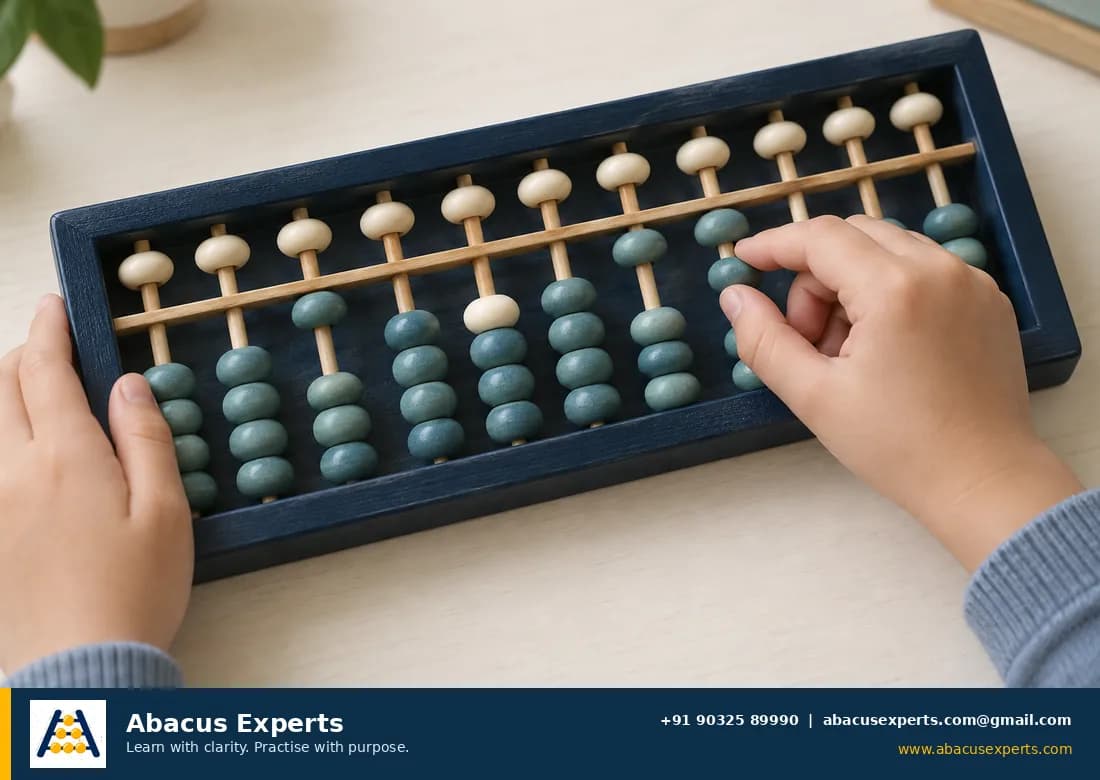
The worked examples use a common Japanese-style soroban with one upper bead and four lower beads on each vertical rod. The upper bead represents five units of that rod. Each lower bead represents one unit. A bead counts only when it is moved toward the central beam.
This is different from a classroom counting frame with rows of ten horizontal beads. Both tools may be called an abacus, but they do not display numbers in the same way. If your child’s device looks different, use the method supplied by the trainer rather than copying these movements blindly.
| Part or convention | Meaning in this guide |
|---|---|
| Upper bead | Worth 5 in its rod when it touches the beam |
| Lower bead | Worth 1 in its rod when it touches the beam |
| Units rod | The chosen reference rod for ones; it is not always the far-right rod |
| Rod to the left | Ten times the value of the rod immediately to its right |
| Clear position | No beads touching the beam; the displayed value is zero |
For the full parts, history and physical-to-mental learning sequence, read what an abacus is and how it works. This article stays focused on examples.
Clear, choose units, then calculate
How to Read These Abacus Examples
- 1
Clear the frame
Move every bead away from the central beam. The displayed value should be zero before a new problem begins.
- 2
Choose the units rod
Use a reference dot or trainer instruction. The next rods to the left become tens, hundreds and thousands.
- 3
Build the starting number
Read each digit by place. Preserve an empty rod when a digit is zero.
- 4
Apply one change at a time
Use a direct bead movement when available. Use a complement only after that relationship has been taught.
- 5
Read and check the answer
Name every occupied place, then verify the arithmetic independently.
Language note
Some programmes call complements “friends” or “partners.” The name may change, but the number relationship must remain correct.
Begin with digits and place value
Abacus Number Examples: 4, 7, 24 and 503
Example 1 — Represent 4
| Step | What happens |
|---|---|
| Start | Clear the chosen units rod. |
| Required change | Build four units. |
| Bead relationship | Move four lower beads toward the beam. |
| Result | The units digit is 4. |
| Check | No upper bead is active; exactly four lower beads touch the beam. |
Example 2 — Represent 7 (5 + 2 = 7)
| Step | What happens |
|---|---|
| Start | Clear the chosen units rod. |
| Required change | Build seven units. |
| Bead relationship | Move the upper bead worth 5 and two lower beads worth 2 toward the beam. |
| Result | The units digit is 7. |
| Check | One upper bead and two lower beads are active: 5 + 2. |
Example 3 — Represent 24 (20 + 4 = 24)
| Step | What happens |
|---|---|
| Start | Clear the tens and units rods. |
| Required change | Build two tens and four units. |
| Bead relationship | Activate two lower beads on tens and four lower beads on units. |
| Result | Read 2 tens and 4 ones: 24. |
| Check | The rods show 20 + 4, not six separate units. |
Example 4 — Represent 503 (500 + 0 + 3 = 503)
| Step | What happens |
|---|---|
| Start | Clear the hundreds, tens and units rods. |
| Required change | Build five hundreds, zero tens and three units. |
| Bead relationship | Activate the upper bead on hundreds, leave tens clear and activate three lower units. |
| Result | Read 5 hundreds, 0 tens and 3 ones: 503. |
| Check | The empty tens rod must be read as zero, not removed from the number. |
Example 4 is especially useful because it tests place value. A beginner who reads only the visible beads may say 53. The empty tens position is what makes the number 503.
Use available beads before complements
Direct Abacus Addition Examples
Direct addition means the required beads can be moved toward the beam without exchanging through 5 or 10. These examples build accuracy before complement methods.
Example 5 — Add 2 + 1 (2 + 1 = 3)
| Step | What happens |
|---|---|
| Start | Show 2 with two lower units. |
| Required change | Add one unit. |
| Bead relationship | Move one more lower bead toward the beam. |
| Result | Three lower beads are active: 3. |
| Check | Count 2, then one additional unit; no upper bead is needed. |
Example 6 — Add 6 + 2 (6 + 2 = 8)
| Step | What happens |
|---|---|
| Start | Show 6 with the upper bead and one lower bead. |
| Required change | Add two units. |
| Bead relationship | Move two available lower beads toward the beam. |
| Result | The rod shows 5 + 3 = 8. |
| Check | The upper bead remains active and three lower beads now touch the beam. |
Example 7 — Add 21 + 13 (21 + 13 = 34)
| Step | What happens |
|---|---|
| Start | Show two tens and one unit. |
| Required change | Add one ten and three units. |
| Bead relationship | Activate one lower tens bead, then three lower units beads. |
| Result | Three tens and four units: 34. |
| Check | 20 + 10 = 30 and 1 + 3 = 4. |
When a direct bead is unavailable
Abacus Addition Examples Using Complements of 5 and 10
A complement rewrites the required change into an equivalent change that the available beads can show. It is not a shortcut to memorise without meaning. The learner should know why the relationship is equal.
Friends of 5
- 1 + 4
- 2 + 3
Friends of 10
- 1 + 9
- 2 + 8
- 3 + 7
- 4 + 6
- 5 + 5
Example 8 — Add 3 + 4 across 5 (3 + 4 = 3 + 5 − 1 = 7)
| Step | What happens |
|---|---|
| Start | Show 3 with three lower units. |
| Required change | Add 4, but only one lower bead remains available. |
| Bead relationship | Use +4 = +5 −1: activate the upper bead and remove one lower bead. |
| Result | The rod shows 5 + 2 = 7. |
| Check | The net change was +4 because +5 −1 equals +4. |
Example 9 — Add 8 + 7 across 10 (8 + 7 = 8 + 10 − 3 = 15)
| Step | What happens |
|---|---|
| Start | Show 8 as the upper bead plus three lower units. |
| Required change | Add 7, which cannot fit directly on the units rod. |
| Bead relationship | Use +7 = +10 −3: remove three lower units and activate one lower tens bead. |
| Result | One ten and five units: 15. |
| Check | The net change was +7 because +10 −3 equals +7. |
Method caution
Programmes can differ in spoken formulas and exact finger order. Keep the arithmetic relationship fixed and follow one trainer’s physical method consistently.
Remove only what is available
Direct Abacus Subtraction Examples
Direct subtraction removes active beads without exchanging through 5 or 10. Begin by checking that the starting number is represented correctly.
Example 10 — Subtract 9 − 4 (9 − 4 = 5)
| Step | What happens |
|---|---|
| Start | Show 9 with the upper bead and four lower beads. |
| Required change | Subtract four units. |
| Bead relationship | Move all four lower beads away from the beam. |
| Result | Only the upper bead remains active: 5. |
| Check | 9 − 4 equals 5, and the displayed bead is worth 5. |
Example 11 — Subtract 13 − 2 (13 − 2 = 11)
| Step | What happens |
|---|---|
| Start | Show one ten and three units. |
| Required change | Subtract two units. |
| Bead relationship | Move two lower units beads away from the beam. |
| Result | One ten and one unit: 11. |
| Check | The tens rod did not change; only the units moved from 3 to 1. |
Example 12 — Subtract 43 − 12 (43 − 12 = 31)
| Step | What happens |
|---|---|
| Start | Show four tens and three units. |
| Required change | Subtract one ten and two units. |
| Bead relationship | Remove one lower tens bead and two lower units beads. |
| Result | Three tens and one unit: 31. |
| Check | 40 − 10 = 30 and 3 − 2 = 1. |
Exchange through 5 or 10
Abacus Subtraction Examples Using Complements
Example 13 — Subtract 6 − 3 across 5 (6 − 3 = 6 − 5 + 2 = 3)
| Step | What happens |
|---|---|
| Start | Show 6 with the upper bead and one lower bead. |
| Required change | Subtract 3, but only one lower bead is available to remove. |
| Bead relationship | Use −3 = −5 +2: remove the upper bead and add two lower beads. |
| Result | Three lower beads are active: 3. |
| Check | The net change was −3 because −5 +2 equals −3. |
Example 14 — Subtract 15 − 7 across 10 (15 − 7 = 15 − 10 + 3 = 8)
| Step | What happens |
|---|---|
| Start | Show one ten and five units. |
| Required change | Subtract 7 from the number. |
| Bead relationship | Use −7 = −10 +3: remove one ten and add three lower units. |
| Result | The units rod shows 5 + 3 = 8. |
| Check | The net change was −7 because −10 +3 equals −7. |
Apply place value without changing the method
Abacus Example 15: Add ₹45 + ₹23
The rupee sign gives the arithmetic a familiar context; it does not change the bead values. Children should still follow normal money-safety guidance and adult supervision in real transactions.
Example 15 — Add two money amounts (₹45 + ₹23 = ₹68)
| Step | What happens |
|---|---|
| Start | Show four tens and five units. |
| Required change | Add two tens and three units. |
| Bead relationship | On tens, use +2 = +5 −3: activate the upper bead and remove three lower beads. On units, add three lower beads directly. |
| Result | Six tens and eight units: ₹68. |
| Check | ₹40 + ₹20 = ₹60 and ₹5 + ₹3 = ₹8; total ₹68. |

Multiplication and division come later
Can Abacus Examples Include Multiplication, Division and Decimals?
Yes, but those examples need more than a final answer. Formal multiplication and division use planned positions for the numbers and answer. Layout conventions can differ between teaching systems, so this beginner article does not present one advanced sequence as universal.
| Operation | Safe beginner concept | What still needs instruction |
|---|---|---|
| Multiplication | 4 × 3 can be understood as 4 + 4 + 4 = 12 | Formal multiplier, multiplicand and answer placement |
| Division | 84 ÷ 4 = 21 can be checked because 21 × 4 = 84 | Dividend, divisor, quotient placement and step sequence |
| Decimals | With an agreed units rod, 12.5 uses tens, units and tenths rods | Decimal reference, precision and consistent reading |
| Mental abacus | A trained learner may later picture familiar bead movements | Stable physical technique and guided progression first |
See the 12-stage abacus syllabus for the order in which Abacus Experts introduces operations. The syllabus—not a random online example—should determine what a learner practises next.
Attempt first, then check the answer key
Abacus Example Questions with Answers
12 practice questions
- Represent 8 on one units rod.
- Represent 42 using tens and units.
- Represent 306 using hundreds, tens and units.
- Solve 21 + 12.
- Solve 43 − 11.
- Solve 2 + 4 using a complement of 5 if required.
- Solve 8 − 4 using a complement of 5 if required.
- Solve 7 + 6 using a complement of 10.
- Solve 14 − 8 using a complement of 10 and any already-taught smaller adjustment.
- Solve 34 + 29.
- Solve 61 − 27.
- Represent 1,007 without losing the two zero places.
Answer key
- 8: upper bead 5 plus three lower beads.
- 42: four tens and two units.
- 306: three hundreds, zero tens and six units.
- 33.
- 32.
- 6: 2 + 4 = 2 + 5 −1.
- 4: 8 − 4 = 8 −5 +1.
- 13: 7 + 6 = 7 +10 −4.
- 6: the exact physical sequence depends on the complement steps already taught.
- 63.
- 34.
- 1,007: one thousand, zero hundreds, zero tens and seven units.
These are checking questions, not a level-placement test. If a child has not yet learned the required complement, use a simpler direct example instead of prompting a memorised movement.
Correct method matters with the correct answer
How to Check a Worked Abacus Example
Units rod
Confirm the chosen units reference before reading any digit.
Starting number
Read the complete starting value aloud, including zero places.
Operation sign
Check whether beads should be added or removed before the first movement.
Complement
State the equality—such as +7 = +10 −3—before using it.
First wrong move
Correct the earliest incorrect movement instead of only replacing the final answer.
Independent check
Verify the arithmetic on paper or with a calculator after reading the abacus result.
A correct final number does not prove the bead method was correct. Consistent technique matters because a lucky shortcut that works on one simple sum can fail on a multi-digit problem.
Find the first source of error
10 Common Mistakes in Abacus Examples
| Mistake | Why it changes the answer | Correction |
|---|---|---|
| Not clearing the frame | An old bead remains part of the new starting number | Reset to zero before every example |
| Counting inactive beads | Beads away from the beam do not count in this soroban convention | Read only beads touching the beam |
| Changing the units rod | Every place value shifts | Choose and keep one reference rod |
| Ignoring a zero place | 503 may be misread as 53 | Name every place, including empty ones |
| Mixing abacus types | A counting frame and a 1:4 soroban encode numbers differently | Use instructions for the actual device |
| Moving the wrong rod | One unit can become ten or one hundred | Say the place value before moving |
| Using the wrong complement | The net change is no longer the requested number | Write or say the equality first |
| Mixing finger systems | Inconsistent technique creates avoidable movement errors | Follow one trainer’s method |
| Chasing speed | Fast repetition can reinforce an incorrect sequence | Stabilise accuracy before timing |
| Checking only the answer | The first wrong move remains unexplained | Replay the example step by step |
Examples are one part of a learning pathway
What Should a Child Learn After These Abacus Examples?
A beginner who can read and build numbers should strengthen direct addition and subtraction before relying on complements. Five-complements come before larger exchanges in many pathways; ten-complements and multi-digit regrouping follow when the foundation is stable. Multiplication, division, decimals and mental visualisation belong later.
Written examples cannot show whether a child is using the intended fingers, keeping the correct posture or making a hidden extra movement. Live correction helps identify those details. Abacus Experts trainer Joshna has 10 years of teaching experience, and the free assessment is the appropriate place to discuss a child’s current starting point.
30 direct answers for parents
30 Abacus Examples FAQs for Beginners and Parents
These questions cover the follow-up details parents commonly need after reading this guide.
What is a simple abacus example for a beginner?
Representing 7 is a useful first example on a standard 1:4 soroban. Move the upper bead, worth 5, toward the beam and add two lower beads, worth 2. The active value is 5 + 2 = 7.
What does the correct zero position look like on an abacus?
On a standard soroban, zero means no bead touches the central beam. Upper beads stay away above the beam and lower beads stay away below it. Clear every rod before starting a new example.
How do you show the numbers 1 to 9 on one abacus rod?
Use one to four lower beads for 1–4, the upper bead for 5, and the upper bead plus one to four lower beads for 6–9. Only beads moved toward the beam count.
Why is 5 represented by one upper bead?
The common 1:4 soroban groups five units into one upper bead. This compact design lets one rod represent digits 0–9 without needing nine separate lower beads.
How do you represent 10 on an abacus?
Choose a units rod, leave it at zero, and activate one lower bead on the tens rod immediately to its left. That one tens bead represents 10.
How do you show a two-digit number such as 23?
Activate two lower beads on the tens rod and three lower beads on the units rod. Read it as 20 + 3 = 23.
How do you represent numbers containing zero, such as 40, 205 or 1,007?
Keep the zero place on its correct rod with no active beads. For 205, show two hundreds, no tens and five ones. Do not remove the empty tens position from the place-value reading.
How do you read a number from the bead positions?
Identify the chosen units rod, read each active digit from the highest occupied place toward the right, and preserve any empty rods between occupied places as zeros.
How do you solve 3 + 4 on an abacus?
Start with three lower beads. Because only one more lower bead is available, use the 5-complement relationship +4 = +5 −1: activate the upper bead and remove one lower bead. The result is 7.
How do you solve 23 + 14 without regrouping?
Start at 23 and add one ten directly. On the units rod, 3 + 4 needs the 5-complement: use +4 = +5 −1. The tens become 3 and the ones become 7, so the answer is 37.
How do you add across 5, as in 4 + 3?
Use the complement of 3 to 5. Since 3 = 5 −2, add the upper bead and remove two lower beads from the starting 4. The result is 7.
How do you add across 10, as in 8 + 7?
Use the complement of 7 to 10. Since 7 = 10 −3, remove three ones and add one ten. Starting from 8, that leaves five ones and one ten: 15.
How do you solve 9 − 4 directly on an abacus?
Start with the upper bead and four lower beads active. Move the four lower beads away from the beam. The upper bead remains, so the answer is 5.
How do you subtract across 5, as in 7 − 3?
Use −3 = −5 +2. Remove the upper bead worth 5, then add two lower beads. Starting from 7, the result is 4.
How do you subtract across 10, as in 15 − 7?
Use −7 = −10 +3. Remove one ten and add three ones. The five ones already present become eight, so the result is 8.
How do you solve a mixed example such as 6 + 7 − 4?
Complete one operation at a time and check after each result. Six plus seven is 13; then subtract four to reach 9. A learner should use only the complement rules already taught for those steps.
What does carrying from ones to tens look like on an abacus?
Ten units are exchanged for one active bead on the tens rod. In 8 + 7, the learner adds one ten and adjusts the ones by the complement, finishing at one ten and five ones.
What does borrowing from tens look like in an abacus subtraction example?
One ten is removed and an equivalent adjustment is made in the ones rod. The exact finger sequence depends on the taught method, so a beginner should learn it from one consistent instructor rather than mixing videos.
How is 12 × 3 solved on an abacus?
Conceptually, 12 × 3 equals 12 + 12 + 12 = 36. Formal soroban multiplication uses a planned rod layout and sequence that belongs to a later stage; this beginner guide does not present one layout as universal.
How is 84 ÷ 4 solved on an abacus?
The arithmetic answer is 21 because 4 fits into 8 tens twice and 4 ones once. Formal abacus division requires an agreed dividend, divisor and answer layout, which should be taught after foundational operations.
How is a decimal such as 12.5 represented on an abacus?
First choose and mark the units rod. Show one ten to its left, two units on it and five tenths on the rod to its right. Decimal work should begin only after the place convention is clear.
In what order should a beginner practise abacus examples?
Begin with zero and digits 1–9, then two- and three-digit place value, direct addition and subtraction, complements of 5, complements of 10, regrouping and only later multiplication or division.
How can a learner check an abacus answer?
Check the chosen units rod, starting value, operation sign, each place-value change and the final number. Then verify the arithmetic independently on paper or with a calculator.
How can you identify whether an error came from place value, bead value or an operation step?
Replay the example from the beginning. If the initial number is wrong, check place value; if one digit is misread, check bead value; if the start is correct but the result changes incorrectly, inspect the first operation step.
Should a worked abacus example show every bead movement or only the final position?
A beginner example should show the starting position, each essential relationship and the final check. A final position alone cannot explain whether the correct method was used.
How can you tell whether an example is too easy, suitable or too difficult for a learner?
A suitable example uses methods the learner has already been taught and can complete accurately with limited prompting. Repeated guessing or an unfamiliar complement usually means the example should be simplified.
Why can the same number look different on a soroban and a school counting abacus?
A soroban uses place-value rods with one upper and four lower beads, while a counting frame often has ten beads on each horizontal row. The devices use different layouts, so their visual representations should not be mixed.
Why can an online abacus demonstration appear reversed or mirrored?
A front-facing camera or meeting setting can mirror the video. Confirm which rod the instructor has chosen as units and follow the spoken place values rather than copying left and right without checking.
How can a parent tell whether a child understands an example instead of memorising bead movements?
Ask the child to name the starting number, explain the value of the rod being changed, solve a similar example with different digits and check the result independently.
Is an abacus example correct if the final answer is right but the bead movement is wrong?
The arithmetic answer may be right by chance, but the example is not technically secure. Incorrect movement can create errors in harder sums, so the first wrong step should be corrected before speed is increased.
Method references and editorial scope
Sources Used for This Abacus Examples Guide
- Japan Society: Soroban teaching scheme Educational objectives for representing numbers, place value, number bonds, addition and subtraction.
- Japan Society: representing numbers 1–9 A beginner teaching resource for reading one rod before moving to larger place values.
- Japan Society: representing two-digit numbers Place-value examples up to 99 using a soroban.
- Japan Society: addition examples Teaching resource for one- and two-digit addition.
- Japan Society: subtraction examples Teaching resource for one- and two-digit subtraction.
- Frank and Barner (2012): representational systems for arithmetic Peer-reviewed description of soroban bead values, place-value columns and physical-to-mental representation.
- Zhang et al. (2020): review of abacus training research Research context for physical and mental abacus learning, with limitations on broad claims.
- Abacus Experts: 12-stage syllabusThe site’s own learning order for direct operations, complements and later-stage calculation.
Editorial limit: the equations are exact arithmetic examples. Spoken formulas, finger use, chosen units rod and advanced-operation layouts can differ by teaching system. This page does not replace trainer correction and does not promise speed, marks, IQ, memory or concentration outcomes.