
Fast facts before the detail
At a Glance: What Parents Need to Know
This summary answers the main decision points. The sections below explain the method, conditions and limitations in context.
| Current programme age guide | Approximately 5–13 years; this is not a universal limit on who can learn an abacus method. |
|---|---|
| Minimum age guide | About five, provided the child can engage with the starting activity comfortably. |
| Maximum age guide | About 13 for the published children’s programme; confirm options outside this range. |
| Junior and Senior | Junior generally covers ages 5–8; Senior generally covers ages 8–13. |
| Readiness checks | Number familiarity, brief attention, simple directions, bead comfort and willingness to practise. |
| First step | A free readiness or placement assessment before choosing a programme and batch. |
Programme eligibility is not a biological cutoff
What Does ‘Abacus Classes Age Limit’ Mean?
An age limit tells parents which learners a particular course is organised to teach. At Abacus Experts, the published children’s pathways cover approximately ages 5–13. The range helps organise lesson length, activity style, batch expectations and curriculum placement.
It does not mean that every five-year-old is ready, that every 13-year-old should begin, or that a person becomes unable to learn an abacus method after 13. Those are different questions. Learning ability, programme eligibility and correct starting level should not be treated as the same thing.
| Question | What answers it |
|---|---|
| Can this programme accept the child? | The provider’s published age guide and available batches |
| Is the child ready to begin? | Number familiarity, instruction-following, bead comfort and response to a short activity |
| Where should the child start? | Current skill, previous learning, technique and placement observation |
| Can an older person learn abacus? | An age-appropriate course and teaching method—not the children’s eligibility range alone |
Short answer: approximately 5–13 is the Abacus Experts programme guide. It is not a law, medical rule or universal industry standard.
One programme, age-appropriate starting decisions
Abacus Classes Age Guide: Under 5, Ages 5–13 and Older Learners
| Age or stage | Current Abacus Experts guidance | Useful next step | Do not assume |
|---|---|---|---|
| Under about 5 | Outside the standard published course guide | Use playful counting and age-appropriate manipulatives; review readiness later | Earlier enrolment is always better |
| About 5–8 | Junior Abacus Classes | Check number familiarity, short directions, bead comfort and willingness to practise | Every five-year-old is automatically ready |
| About 8–13 | Senior Abacus Classes | Check the beginner or continuing level from current skill and previous learning | An older beginner should skip physical foundations |
| Previously trained | Placement after a practical skill check | Show actual bead technique, place value, operation accuracy and independence | A former certificate maps directly to the same stage |
| Over 13 or adult | The Junior and Senior courses are not adult programmes | Use the separate teacher-training enquiry only when the goal is to prepare to teach; ask separately about other adult learning | A teacher enquiry or children’s batch is automatically suitable |
Age bands organise teaching; they do not rank children. A recommendation to begin slowly, revise a foundation or wait protects the learner’s experience. It is not a judgement about intelligence or long-term ability.
About five is a starting guide
What Is the Minimum Age for Abacus Classes?
The minimum age guide at Abacus Experts is approximately five. That means a ready five-year-old may be considered for the Junior pathway; it does not make fifth birthdays an automatic admission date.
A younger beginner needs concrete, visible steps. The child should be able to recognise at least some numerals, count small quantities with growing stability, watch a short demonstration and try a controlled bead movement. Fast addition, long attention or previous abacus knowledge is not required.
A five-year-old may be ready when
- The starting numbers are familiar
- A short instruction can be attempted
- The child is comfortable touching and moving beads
- Gentle correction does not create sustained distress
- The family can support a brief routine
More preparation may help when
- Numbers in the starting task are not yet recognised
- The child cannot engage even with a very short supported activity
- Bead movement feels uncomfortable or overwhelming
- The child strongly resists every attempt
- The weekly routine cannot be sustained
For children under five, playful counting, sorting and quantity activities can build useful foundations without turning an enrichment course into a race.
Programme boundary, not learning impossibility
What Is the Maximum Age for Children’s Abacus Classes?
About 13 is the current upper guide for the published Abacus Experts children’s programme. Children aged 11, 12 or 13 may still begin, subject to assessment and an appropriate Senior batch. They should not be described as “too old” simply because they did not start at five.
The upper guide exists because a course is designed around a particular age group, class rhythm and curriculum—not because the human ability to learn bead calculation suddenly ends. Studies discussed in the cited review include older participants, including young adults. This supports the limited inference that the provider’s 5–13 range should not be treated as a proven biological cutoff; it does not confirm that an adult or older-teen programme is available here.
What parents should confirm for ages 12–13
Ask about the actual beginner starting stage, available time before other school demands increase, the learner’s goal, current batch fit and whether the child is comfortable learning foundations rather than being rushed to “catch up.”
Five practical observations
5 Signs a Child May Be Ready to Start Abacus
Some number familiarity
The child recognises at least some age-appropriate numerals and can attempt one-to-one counting. Perfect counting or fast arithmetic is not required.
Short, supported attention
The child can watch a brief demonstration and return to the activity after a prompt. Readiness does not require sitting silently for a long period.
Simple direction-following
The child can try one or two visible steps, such as choosing a column and moving a bead after the trainer demonstrates it.
Fine-motor comfort
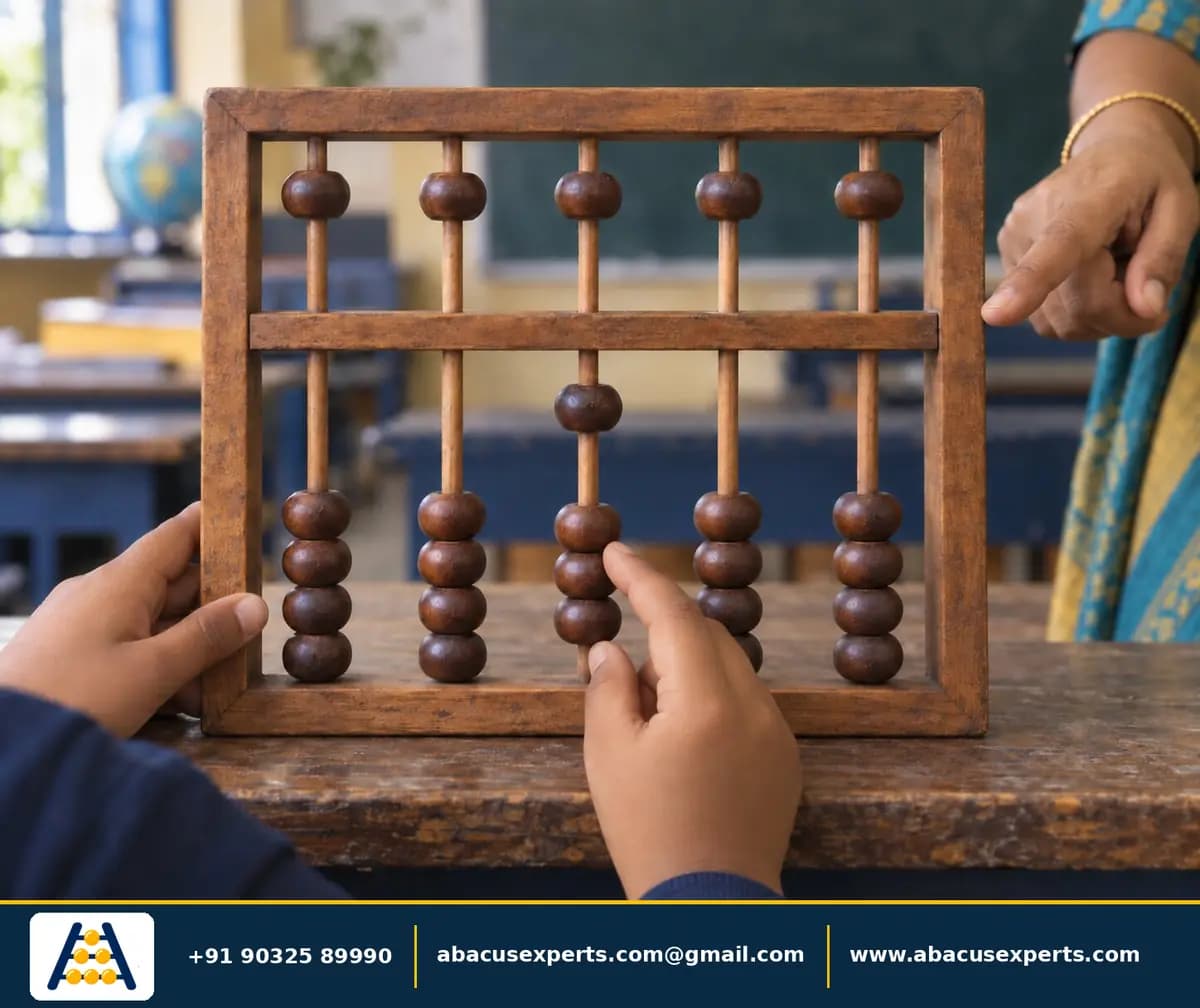
The child is willing to use a finger to move small beads with reasonable control. Technique can be taught; willingness and comfort matter first.
Willingness to practise
The child can attempt a short repeated activity without the session becoming a daily conflict. Interest may grow, but constant pressure is not a sound foundation.
These are learning observations, not developmental diagnoses. If a parent has concerns about the child’s learning, vision, motor skills, attention or development, an abacus readiness assessment does not replace advice from the appropriate qualified professional.
Studies describe participants, not a universal cutoff
Does Research Prove One Best Age for Learning Abacus?
No cited study establishes one universal best age, minimum age or maximum age for every child. Research programmes use particular ages, schools, teaching periods and outcomes. Their results can inform expectations, but they cannot turn one participant group into an admission rule for all providers.
| Evidence | What it found | What it does not prove |
|---|---|---|
| Barner et al., 2016 | A three-year randomized trial began with children aged 5–7 and reported arithmetic gains; starting visuospatial working memory predicted how well the method was learned. | That every child should start at five, or that age alone predicts success |
| Barner et al., 2018 | In a one-year first- and second-grade trial, second graders learned the technique more successfully, while neither grade showed a significant computation or cognitive advantage over the comparison curriculum. | That “earlier is always better” or one year guarantees a wider outcome |
| Wang et al., 2015 | A longitudinal study recruited seven-year-olds and reported arithmetic and visual-spatial mathematics differences after training. | A universal programme age limit or identical results in another setting |
| Zhang et al., 2020 review | The review discusses child and young-adult studies and says more work is needed to determine whether age moderates outcomes. | That learning becomes impossible after a particular birthday |
Responsible conclusion: age affects how teaching may need to be organised, but readiness, teaching quality, practice and programme fit also matter. Research findings should not be converted into guaranteed enrolment outcomes.
Grade provides context, not automatic placement
Should School Class or Age Decide the Starting Level?
Neither one should decide the level alone. School class tells the trainer which arithmetic ideas a learner may have encountered, but it does not show whether the child knows bead values, uses correct finger technique or can visualise an abacus.
| Information | How it helps | Why it is not enough alone |
|---|---|---|
| Age | Guides the suitable programme and activity style | Children of the same age have different readiness and experience |
| School grade | Shows likely exposure to number concepts | School curricula and individual understanding vary |
| Previous abacus course | Shows possible learned material | Providers use different stages, methods and standards |
| Practical placement check | Shows current technique, accuracy and independence | It is a snapshot and should be interpreted with parent context |
A beginner does not need to know fast addition or subtraction before the assessment. Basic numeral recognition and counting familiarity are more useful foundations; operations are then introduced through the published 12-stage abacus syllabus.
Starting later can still be appropriate
Is Age 9, 10, 11, 12 or 13 Too Late to Learn Abacus?
No. These ages fall within the current Abacus Experts Senior programme guide. An older learner may understand explanations and written number relationships differently from a younger beginner, but that does not mean the child should skip correct bead technique or place-value foundations.
The useful question is not “Will my child catch up with someone who started earlier?” Children may have different goals, practice histories and learning pace. The useful questions are:
- Is the child interested enough to try the method?
- Can the chosen batch match a beginner’s starting point?
- Will school and activity schedules allow steady practice?
- Can the trainer explain progress without comparing children?
- Does the child understand that accuracy comes before speed?
- Can the family sustain the chosen online or classroom format?
An older beginner may decide after the assessment that abacus is suitable, that another form of maths support fits better, or that the timing is not right. A useful assessment allows all three conclusions.
Check retained skill, not labels
How Should a Returning or Transfer Student Be Placed?
A child who attended abacus elsewhere should not automatically restart at the first stage, but should not be placed only from a former level name either. Providers may use different level counts, bead methods, workbooks and progression standards.
A placement check can ask the child to represent numbers, demonstrate finger movement, complete familiar operations and explain what they are doing. The trainer can then identify which skills are secure, which need correction and which have not yet been learned.
Useful evidence
- The child’s actual working technique
- Accuracy on previously learned operations
- Comfort with place value
- Ability to work independently
- Previous books, reports or certificates as supporting context
Insufficient by itself
- The former programme’s level name
- How many months the child attended
- A claim that the child was “advanced”
- Speed without a technique check
- Age alone
The age guide is shared; the learning setting differs
Does Online or Classroom Learning Change the Age Limit?
No separate age range is currently published for the two formats. Live online and Hyderabad classroom classes both use the approximate 5–13 guide, Junior and Senior pathways and the same underlying curriculum. The better question is whether the format allows consistent participation and clear observation.
| Decision point | Live online | Hyderabad classroom |
|---|---|---|
| Trainer observation | Requires a camera view of the working hand, abacus and learner | Allows direct face-to-face observation at the table |
| Younger-child setup | An adult may need to prepare the device, desk and materials | The centre prepares the classroom setting; family manages travel |
| Routine | Avoids travel but needs a quiet, reliable home setup | Creates a separate learning environment but adds journey time |
| Age decision | Readiness and programme fit matter more than assuming one format is always better for a particular age. |
Junior lessons are usually 45–50 minutes with up to six learners. Senior lessons are usually 55–60 minutes with up to eight learners. Both normally include two live classes each week, subject to the current schedule.
Suitability should be considered individually
What If a Child Has Different Learning or Access Needs?
A diagnosis, disability or learning difference should not be used as an automatic yes or no. Parents should explain the child’s relevant access needs and ask what the trainer and setting can genuinely support. An abacus assessment cannot diagnose or treat a developmental, attention, motor, vision or learning condition.
Useful questions for the provider
- Can the instruction pace be adjusted?
- Can the child have a clearer visual demonstration or repeated step?
- Are breaks, seating or material-size adjustments possible?
- What parent support is expected online?
- How is tiredness or overwhelm handled?
Information parents can share
- How the child best understands instructions
- Any visual, hearing, sensory or motor access need
- Signs that the child is becoming overwhelmed
- Support used successfully in school or other activities
- What the family can sustain at home
Only adjustments that Abacus Experts can actually deliver should be confirmed. When a child needs specialist educational, medical or therapeutic support, families should use the relevant qualified professional rather than treating abacus classes as a substitute.
A pause can protect the learning experience
When Might a Child Need More Time Before Starting?
Waiting can be reasonable when the child is distressed by the activity, cannot yet engage with a brief demonstration even with support, is uncomfortable handling the beads, or has a schedule that makes attendance and short practice unrealistic.
A short introduction may also show that the child needs a gentler number-readiness activity first. That does not predict what the child will be able to do later. Readiness changes with experience, maturity, interest and the learning environment.
| What you notice | A sensible next step |
|---|---|
| The child does not yet recognise the numbers used in the introductory task | Build basic number familiarity and review readiness later |
| Moving the beads causes frustration or discomfort | Try a shorter, supported introduction and discuss motor or visual needs where relevant |
| The child can start but tires quickly | Consider shorter steps and check whether the Junior format is suitable |
| The weekly schedule leaves no consistent practice time | Choose a sustainable batch or postpone rather than enrol under pressure |
Observe, discuss and decide
What Happens in an Abacus Readiness Assessment?
The Abacus Experts assessment is a free starting conversation and activity. It is not an intelligence test and does not require enrolment. Parents can share the child’s age, previous learning and preferred format; the trainer can observe a short number or bead activity and explain a possible pathway.
- 1
Parent context
Discuss age, school stage, previous abacus learning and any practical concerns.
- 2
Short learner activity
Observe number familiarity, instruction-following and comfort with the physical abacus.
- 3
Pathway explanation
Explain why Junior, Senior, revision, a slower introduction or waiting may be suitable.
- 4
Format and batch check
Compare live online and Hyder Nagar classroom options against the child’s needs and family routine.
- 5
Informed decision
Review the current fee, kit, schedule and policies before choosing whether to enrol.

Format and routine matter locally
What Should Hyderabad Parents Consider Before Enrolment?
For Hyderabad families, readiness is only one part of the decision. A sustainable format also matters. The Hyder Nagar classroom may suit a child who benefits from face-to-face observation and a family that can manage the weekly journey. Live online learning may suit families who want to avoid travel and can provide a quiet desk, clear camera view and adult setup support.
Ask for current days, start times and open seats before planning the routine because batch availability can change. The Abacus Classes in Hyderabad page contains the verified centre address, classroom fee, batch limits, map and enrolment route.
Readiness before urgency
What Is the Final Answer on the Abacus Classes Age Limit?
The Abacus Experts age guide is approximately 5–13 years. Junior generally supports ages about 5–8 and Senior generally supports ages about 8–13. A child’s exact entry point still depends on readiness, current arithmetic foundations and previous abacus learning.
Starting earlier is not automatically better, and beginning at 9, 10, 11, 12 or 13 is not automatically too late. Outside the published range, ask whether a suitable course exists instead of assuming the children’s batch applies. Choose from observed fit and a sustainable routine—not fear about missing a supposed brain-development deadline.
One useful next step
Use the free assessment to answer one practical question: can this child engage with the current starting activity comfortably, and which available pathway best fits what the trainer observes?
30 direct answers for parents
30 Questions Parents Ask About the Abacus Classes Age Limit
These questions cover the follow-up details parents commonly need after reading this guide. Every answer remains open, concise and easy to read.
What is the age limit for abacus classes?
At Abacus Experts, the children’s programme is designed mainly for ages about 5–13. Age is the first eligibility guide; readiness and previous learning help decide whether the child should join and where the child should begin.
What is the minimum age for abacus classes?
The usual minimum age guide at Abacus Experts is about five. A five-year-old should still complete the free readiness assessment because children of the same age can differ in number familiarity, brief attention and comfort with instructions.
What is the maximum age for abacus classes?
The published upper age guide for the current Abacus Experts children’s programme is about 13. Families should ask before assuming eligibility outside that range because a suitable teenage or adult course has not been published on this website.
What is the best age to start abacus classes?
There is no single research-backed best birthday for every child. A suitable time is when the child fits the programme range and can recognise basic numbers, count, watch a short demonstration, follow simple instructions and move beads comfortably.
Can a four-year-old join abacus classes?
The current Abacus Experts programme normally begins at about age five, so a four-year-old should not be promised admission. Playful counting and handling age-appropriate manipulatives may be a better preparation before readiness is checked later.
Is five years too young to learn abacus?
Not necessarily. A five-year-old may be ready when the child recognises basic numbers, can attempt counting, moves beads with support and participates in a short guided activity. The assessment matters more than age alone.
Can a six- or seven-year-old start abacus classes?
Yes, these ages usually fall within the Junior pathway when the child is ready. Teaching should use concrete bead work, short instructions and accuracy before speed rather than assuming every younger child will learn at the same pace.
Can an eight-year-old start abacus for the first time?
Yes. Eight is near the shared boundary of the Junior and Senior guides, so readiness, arithmetic foundations and the available batch should decide the pathway instead of age alone.
Can a ten-year-old begin abacus without previous experience?
Yes. A ten-year-old can enter the Senior pathway as an older beginner and learn bead values, finger technique and place value before progressing. School arithmetic does not remove the need for a correct physical foundation.
Can a 12- or 13-year-old start abacus classes?
Potentially, yes. Both ages fall within the upper part of the current guide, but placement should consider the learner’s starting point, goals, available batch and realistic time for practice.
Can a teenager older than 13 learn abacus?
A teenager can learn how an abacus works, but Abacus Experts currently publishes a children’s programme for approximately ages 5–13. A family should confirm whether an age-appropriate arrangement exists before planning enrolment.
Can adults learn abacus?
Adults can learn physical-abacus calculation, but the published Junior and Senior courses remain children’s programmes. Abacus Experts now accepts separate teacher-training interest enquiries; that professional enquiry is not a general adult learner course and its current curriculum, batch and trainer availability must be confirmed.
Does school grade decide the right abacus level?
No. School grade provides context, but placement should reflect current number understanding, abacus technique, arithmetic foundations and independence. Two classmates may need different starting stages.
How do I know if my child is ready for abacus classes?
Look for basic numeral recognition, counting attempts, willingness to move beads, ability to watch a short demonstration and capacity to follow one or two simple instructions. The free readiness assessment observes these areas before enrolment.
What should a child know before starting abacus?
A beginner should have some age-appropriate number recognition and counting familiarity. Previous abacus knowledge and fast mental calculation are not required.
Must my child know addition and subtraction before joining?
No. The beginner pathway teaches number representation, place value and early operations progressively. The child still needs enough basic number familiarity to participate comfortably in the starting activity.
How much attention span does a child need for abacus classes?
There is no reliable universal number of minutes that applies to every child. Readiness is better judged by whether the child can watch a brief demonstration, attempt the movement and return to the task with reasonable guidance.
Does a child need strong fine-motor skills to start abacus?
The child should be willing and reasonably comfortable moving beads, with support where appropriate. Neat handwriting is not a substitute test for abacus readiness; any motor or visual difficulty should be discussed before enrolment.
How do you choose between Junior and Senior abacus classes?
Junior is designed mainly for ages about 5–8, while Senior is mainly for ages about 8–13. At the shared age boundary, readiness, existing arithmetic and previous abacus learning help determine placement.
What level should a child with previous abacus experience join?
The trainer should check retained finger technique, number representation, place value, operations and visualisation before recommending a stage. A previous certificate or workbook should be supporting context, not the only placement evidence.
Will two children of the same age start at the same level?
Not necessarily. One may be a first-time learner while another has stable previous skills, so their starting stages can differ even when their ages are the same.
Is the age limit different for online and classroom classes?
No different age range is currently published. Both formats use the same approximate 5–13 guide and curriculum; format suitability depends on whether the trainer can observe, guide and correct the child effectively.
Can a five-year-old attend online abacus classes?
A ready five-year-old may attend online, but an adult may need to prepare the device, desk, camera and materials. The trainer must be able to see the child’s working hand and abacus clearly.
Are classroom abacus classes better for younger children?
Not automatically. Classroom learning allows direct observation, while online learning may support consistent attendance by avoiding travel. The better format is the one in which the child can engage regularly and receive clear correction.
Can a child with special educational needs join abacus classes?
Possibly, but a diagnosis alone cannot confirm or rule out suitability. Parents should explain the child’s learning and access needs, use an individual readiness assessment and ask which adjustments can genuinely be provided.
How long does an abacus course take to complete?
Abacus Experts publishes a 12-stage pathway, but not one guaranteed completion time. Entry stage, attendance, practice, accuracy and revision needs affect progress, so age alone cannot predict a finish date.
How long is each class for Junior and Senior learners?
Junior lessons are usually 45–50 minutes and Senior lessons usually 55–60 minutes. Abacus Experts normally conducts two live classes each week, subject to the current batch schedule.
How much should a beginner practise at home?
The usual starting guide is about 10–15 focused minutes on several days each week. The trainer may adjust this according to age, stage, accuracy and the child’s response to practice.
Do older beginners need extra practice to catch up?
Not simply because they are older. Practice should match the assessed stage and remain accurate; longer sessions can reinforce errors or create pressure. No catch-up timeline should be guaranteed.
What should parents confirm before enrolling a child?
Confirm age eligibility, readiness, recommended stage, Junior or Senior pathway, online or classroom suitability, lesson schedule, batch size, practice expectations, fees, inclusions and written policies. Start with the free readiness assessment.
Programme facts, primary research and official context
Sources, Evidence Limits and Further Reading
No cited source establishes one universal best age for every child to start abacus. The 5–13 range is the confirmed Abacus Experts programme guide. Readiness signs are practical educator observations rather than medical or developmental tests, and research groups should not be turned into universal age rules.
- Barner et al. (2016): three-year randomized mental-abacus trial The study began with children aged 5–7 and found arithmetic gains; it does not establish five as the correct starting age for every child.
- Barner et al. (2018): first- and second-grade classroom trial Second graders learned the method more successfully in this implementation; neither grade showed a significant computation or cognitive advantage over the comparison curriculum after one year.
- Wang et al. (2015): longitudinal study beginning with seven-year-olds The study reported arithmetic and visual-spatial mathematics differences, with design limitations stated by the authors.
- Zhang et al. (2020): review of abacus training research The review discusses child and young-adult research and notes that more work is needed to understand whether age moderates training effects.
- NCERT (2022): National Curriculum Framework for the Foundational Stage Official Indian context for developmentally appropriate, activity-based foundational learning; it does not prescribe an abacus-course starting age.
- Abacus Experts: Junior programmeThe current age guide, class length, group limit and starting pathway for younger learners.
- Abacus Experts: Senior programmeThe current age guide and placement route for older beginners, continuing and transfer learners.
Editorial conclusion: use 5–13 as the Abacus Experts programme range—not as a universal claim. Use the assessment to interpret readiness, and do not promise that an age alone predicts speed, memory, concentration, IQ, school marks or course completion.