

Listen to the Audio
Listen to the Abacus Mental Maths voiceover while following the article.
This is the idea behind Abacus Mental Maths. Children learn to picture an abacus in their minds and imagine its beads moving while they calculate. They do not start by imagining everything at once. They build this skill through physical practice, observation and guided mental exercises.
At Abacus Experts, the learning journey focuses on understanding the method first and developing mental calculation step by step.
How Does a Child Learn to Calculate Without an Abacus?
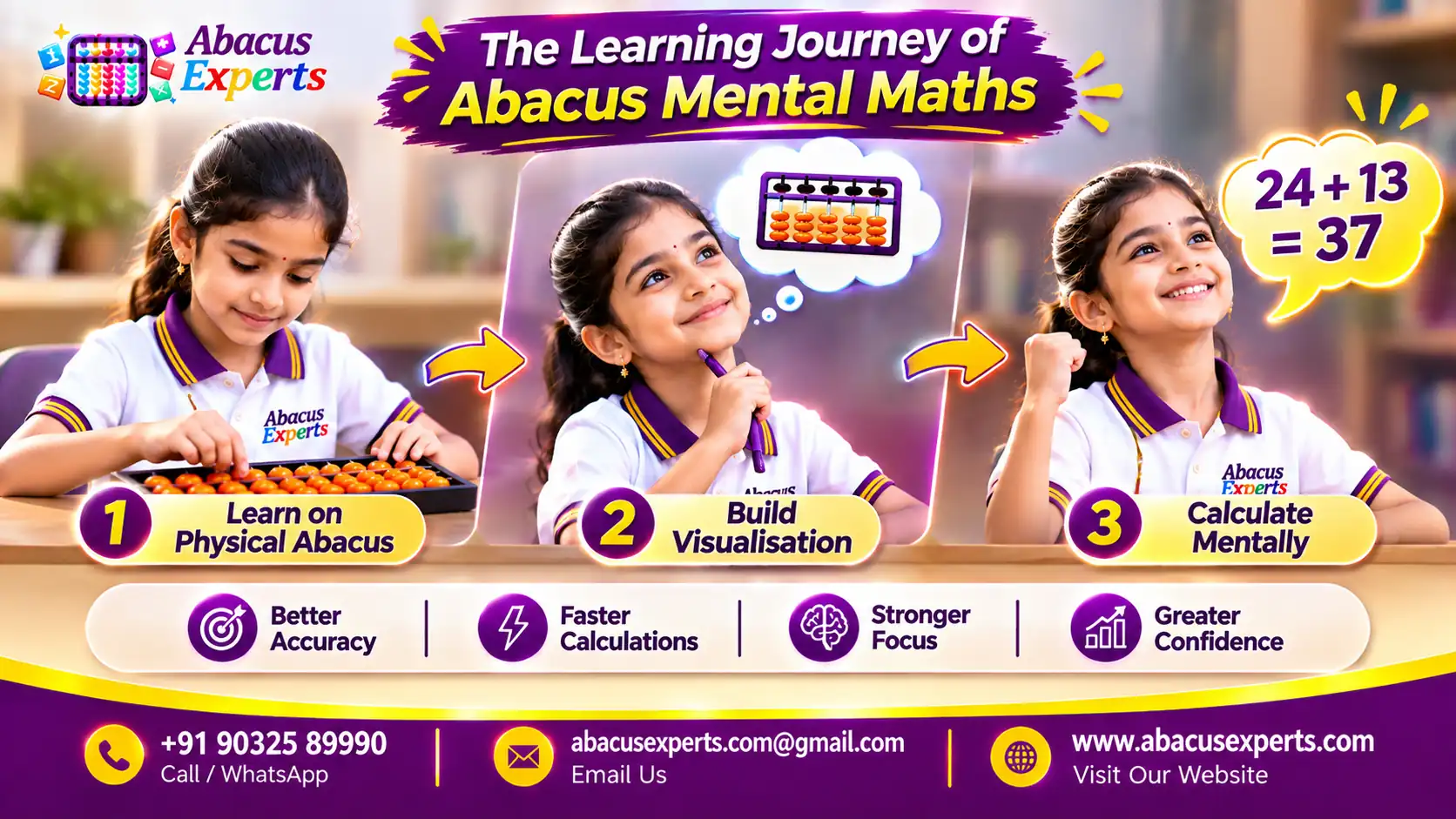
The change from using a real abacus to an imaginary one is not a sudden jump. A child first becomes familiar with the physical instrument. Later, the trainer introduces activities that help the child remember and picture its bead positions.
Here is what this change can look like:
First, the child recognises the pattern. The child becomes familiar with how a number appears on the abacus.
Next, the child remembers the position. The child practises recalling a bead arrangement even when the instrument is not directly in front of them.
Then, the child imagines a change. Instead of physically moving a bead, the child tries to picture what the new arrangement would look like.
Finally, the child calculates mentally. The child uses the imagined bead positions to work through a calculation.
Some children may use finger movements at first to help imagine the beads. With practice, they may become able to perform calculations without those movements. The pace is different for every learner.
For children who are new to the instrument, our Abacus Basics guide explains the starting point.
What Happens Inside the Mind During Mental Abacus?
Think of a physical abacus as a picture the child has learned to understand.
When a child calculates mentally, the child recalls that picture and imagines how its beads would change. The answer comes from the final imagined arrangement.
This is different from simply remembering an answer or guessing it. The child is applying a calculation method using a mental picture.
For example, a learner may be asked to picture a familiar number before attempting a calculation. The trainer can then check whether the child understands the number arrangement before introducing a more difficult task.
This is why mental visualisation needs to develop alongside calculation accuracy. A clear mental picture is more useful than trying to answer quickly.
What Is the Difference Between Anzan and Flash Anzan?
These two terms are related, but they describe different things.
Anzan is mental calculation using an imagined abacus. The learner pictures the abacus and performs calculations without moving its physical beads.
Flash Anzan is a practice activity in which numbers appear one after another for a short time. The learner must follow the sequence, remember the numbers and calculate the result mentally.
For example, a child may see a short sequence such as 4, 3 and 2. The task is to process the numbers and find their total mentally.
Flash Anzan places an additional demand on the learner because the numbers are presented quickly. It is better suited to learners who already have the necessary calculation skills.
You can read more about these terms in the Soroban Exam Anzan guide and the Japanese Abacus Museum glossary.
What Should Parents Expect During Mental Abacus Learning?
Parents often want to know when their child will stop using the physical abacus. There is no fixed date that applies to every child.
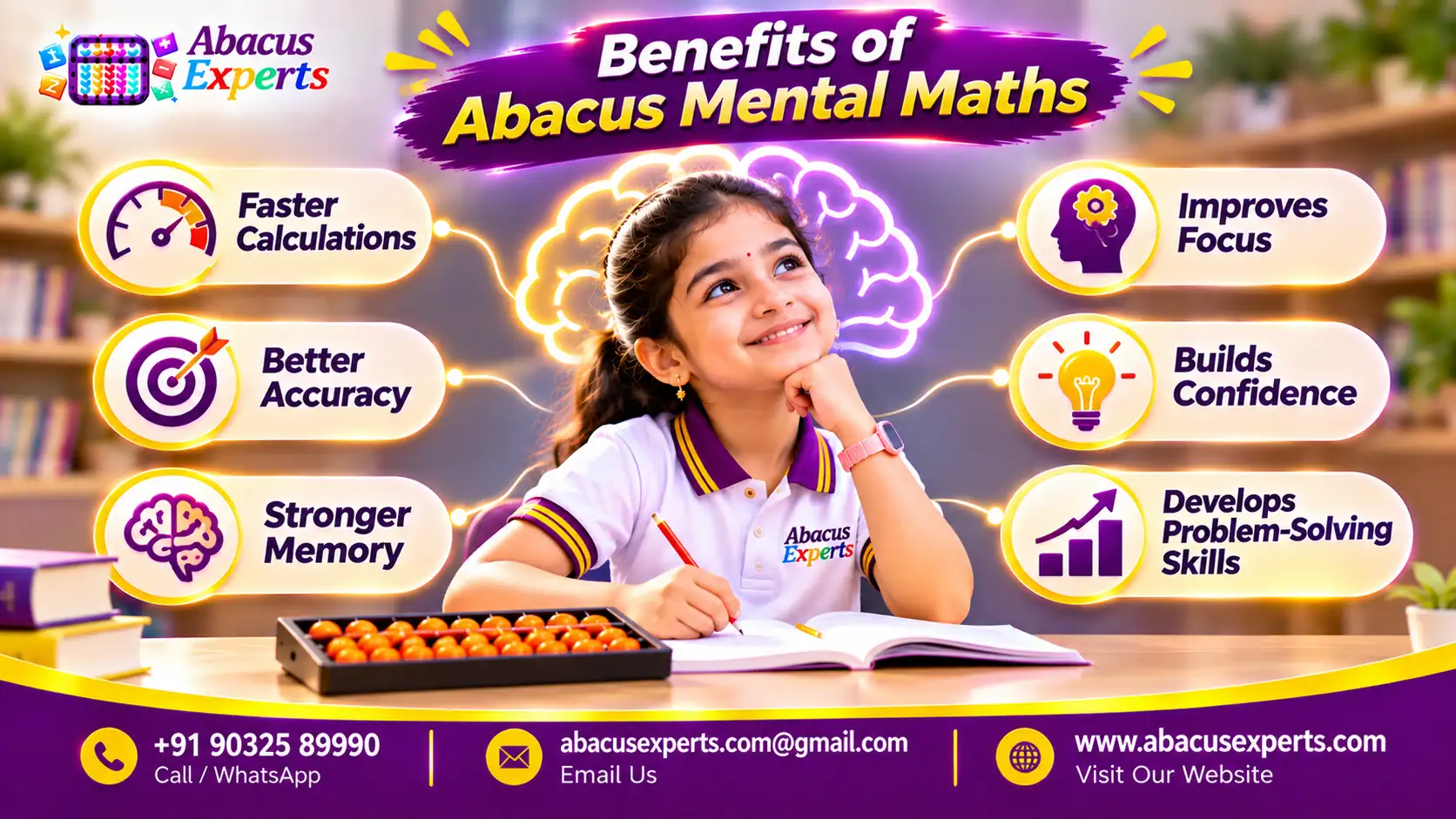
Instead of looking only at speed, notice whether your child can:
- Recognise familiar bead arrangements.
- Explain how a number is represented.
- Recall a number position after looking away.
- Imagine a simple bead movement.
- Follow a familiar calculation without physical support.
- Correct a mistake after receiving guidance.
A child may be comfortable with small calculations but need more support with longer ones. This is a normal reason to continue practising at the current level rather than rushing ahead.
Parents can also read our Abacus Practice at Home guide for ways to support learning outside class.
What Does Research Say About Mental Abacus Training?
Mental abacus has been studied as a method of mathematical learning.
A 2016 controlled study published in Child Development followed 204 elementary-school children. The researchers reported stronger arithmetic performance among children who received mental abacus instruction than among control groups. The study did not find that the training changed basic cognitive abilities.
A 2019 study published in The Journal of Neuroscience examined children who received long-term abacus-based mental calculation training. It reported differences in arithmetic performance and visuospatial working-memory performance.
These findings help explain why researchers are interested in mental abacus learning. They should not be treated as a promise that every child will achieve the same results.
Frequently Asked Questions
What is Abacus Mental Maths?
It is a calculation method in which children imagine an abacus and mentally picture bead movements to solve mathematical problems.
Can a child use an abacus without holding it?
Yes. After learning the physical method and developing visualisation skills, a child can practise calculations using an imagined abacus.
Why do children move their fingers during mental calculation?
Some learners use finger movements as an aid while imagining bead movements. They may gradually reduce this support as their mental calculation skills develop.
Is Anzan the same as Flash Anzan?
No. Anzan refers to mental calculation. Flash Anzan is an activity where numbers are displayed in sequence for the learner to calculate mentally.
How long does it take to learn mental abacus?
There is no fixed timeline. Progress depends on the child's understanding, practice, learning level and guidance.
Should children focus on speed or accuracy?
Accuracy should come first. Speed can be developed gradually after the child understands and follows the correct calculation method.
Explore Abacus Learning with Abacus Experts
Every child develops mental calculation skills at a different pace. A clear learning method, suitable practice and trainer guidance can help children move from physical abacus work towards mental visualisation.
Visit Abacus Experts to learn about our programmes. Parents looking for classroom learning can also explore Abacus Classes in Hyderabad.
Book a free demo to discuss your child's learning readiness.


